[START RECORDING]
FEMALE VOICE: This podcast has been prepared exclusively for institutional, wholesale, professional clients and qualified investors only, as defined by local laws and regulations. Please read other important information which can be found on the link at the end of the podcast episode.
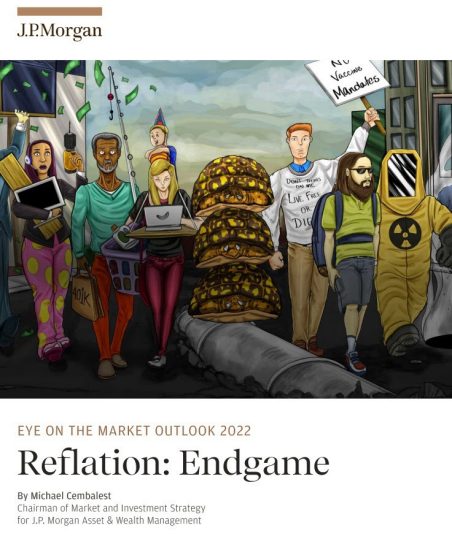
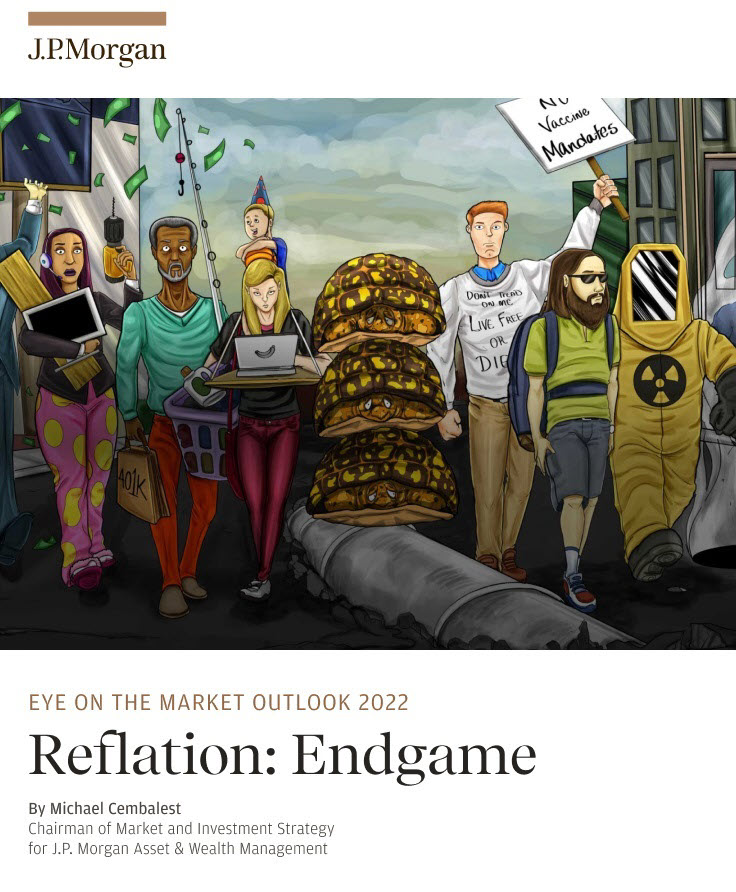
MR. MICHAEL CEMBALEST: Happy New Year, everybody, and welcome to the 2022 Eye on the Market Outlook, which is entitled Reflation Endgame. I’ve never actually seen a superhero movie, but I can imagine what they look like, and I’ve seen the posters for them. So the poster for this year, the cover art for this year’s Eye on the Market, is a group of superheroes, all of whom are contributing in one way or another to rising prices, wages, nominal growth, and asset prices.
And you take a look at the cover art, you’ll see politicians who are creating the largest monetary and fiscal stimulus on record, the impact from all the work-from-home employees that are driving up demand for import and semiconductor-intensive goods, which are worsening supply chain bottlenecks, the big jump in retirees taking advantage of rising home prices and rising 401(k) account values, working mothers, millions of whom are still having trouble finding childcare and the impact that has on the labor markets, the oil and gas and coal producers who have reverted into their shells, they’re depicted as turtles.
Capital spending in new projects for thermal power have fallen by 75%, even though the demand for thermal energy hasn’t really moved much at all. We’ve got a vaccine resistor on the cover and the obvious impacts that has on the labor force, other labor force dropouts and switchers, healthcare regulators passing vaccine mandates, and then one of the other last but important impact on the labor market is about a million in the US missing immigrant workers in the US labor supply. And that follows on the Trump era when immigration fell to its lowest level since the 1980s.
So all of these factors are part of the reflation endgame that’s the theme of this year’s Executive Summary, and we walk through the consequences for equity markets that are already pricing in plenty of good news. The structure of the outlook is always an Executive Summary, and it gets followed by some specific investment topic discussions. This year we review China and the regulatory purge and the prospect for investing there in 2022, what the landscape looks like for dividend investors, and then we take a look, a deep dive into some real asset topics, commercial real estate, office specifically, and the trends taking place there, infrastructure and timber. We also look at investments in Fintech and cybersecurity. And lastly, from a policy perspective, we look at ESG impacts on portfolios and what is now emerging is the pretty high cost of Brexit.
In the Executive Summary, we review the story that you’re all familiar with, with the COVID recession having recovered so quickly to eliminate spare capacity now at a faster pace than prior recessions. We have global inflation close to the highest level in 20 years, which is driven by a number of things, surging goods prices, changing consumption patterns, the inability of adjusted time corporate sector to respond to that, soaring government debt and monetary policy that dwarfs anything we’ve ever seen. And then energy policies which reduce the supply of thermal energy faster than they reduced demand.
And so as the year came to an end, we saw some weakening manufacturing indicators. Normally that’s a negative sign for investors, but this time around, the supply chain shocks, I think, were more responsible for these weakening manufacturing indicators. And that’s why we’re optimistic that with gradual resolution over some period of months of some of the supply chain delays, global growth is going to rebound. And we’re already starting to see, in both the US and Europe, a shift back towards services from goods spending, which was one of the main catalysts for some of these supply chain problems. We’ll see what happens as Omicron rolls through and it may be a temporary reversal. But the bottom line is that the pig through the snake in terms of this surge in goods spending relative to services appears to be abating in the developed world.
Now, I won’t go into the details here, but we do have a page on some of the supply chain issues. This is not just the byproduct of COVID and the shift in spending. There’s a lot of structural issues in the US that are that are negatively affecting the supply chains in terms of local regulations. I won’t go through them all here, but you’ve got to look at this page. No port in the US ranks in the top 50 globally in terms of cost or more important, efficiency and speed. These Los Angeles ports that you read about all the time rank 328 in the world, and Long Beach comes into 333. There are contracts that prevent port automation. There’s limits on operating hours; there’s weekend closures. And the semi-automated Port of Virginia doesn’t have any backlogs and ranks, comes in at about 85. But there’s a lot of issues here in the US that this supply chain stuff has surfaced, which are structural and not just cyclical.
Anyway, we walk through a lot of the usual suspects that we’re tracking regarding some of these supply chain issues, which are still obviously on the high side as we enter the year. The question is how do they get resolved. And if you look historically, there have been some pretty severe supply chain issues that have taken place in the past. And normally what happens is they get resolved within a few months as capital spending catches up to demand. And COVID is a complicating factor, but we expect that to happen this time as well.
A pretty good example of that is the, what now looks like a very large increase in automobile-related semiconductor capital spending, which is expected to double next year versus prior trends, and this is pretty critical for supply chain given the rising number of semiconductors per car. We have a chart in here that looks at semiconductor values per car and the overall automotive electronics cost per car. So with a lot of the goods supply chain issues, eventually we expect capital spending to help resolve some of those shortages in addition to increased vaccination rates in Asia and a gradual reduction in some of the shipping costs.
The challenge here is that while we think that the goods supply chains are going to get better, there are still two problems that we think are going to get solved much more slowly, and the first one of those is obviously labor. US labor shortages appear to be a real chronic issue, driving up wage inflation, very tight labor markets. Last October, we walked through the seven to eight million people that are missing from the labor force for different reasons, whether it’s accelerated retirement, changes in immigration rules, increased self-employment out of large cities, vaccinated people afraid to return to work, working parents can’t find childcare, unvaccinated people that are fired or furloughed from their jobs. The bottom line is the latest data from the BLS shows low-skill wages rising at almost 7% a year. And what we end up with is the tightest labor markets in well over 30 to 40 years.
Now we still don’t know what’s going to happen to the reconciliation bill, given the objections from Manchin, but we could have as much as $2 trillion deployed as direct government purchases and other indirect government purchases. At a time of very tight labor markets, I’m not sure exactly where all the workers are going to come from and what impact that will have on wages at a time of very tight labor markets. So while the goods supply chain issues should resolve themselves over the next two months, the labor ones I don’t think will.
And then again, as I mentioned earlier, energy-related inflation may be pretty sticky. And there has been a massive collapse in oil and gas production investment at a time that global demand for fossil fuels has barely declined. And for everybody that would like to see more rapid de-carbonization, you have to match the decline in the supply and demand of something, or else the price is simply going to go up and you’re going to end up with more imports.
An extreme version of this is found in Europe. Electricity prices are soaring to kind of preposterous levels because their renewable energy policy changed faster than underlying fossil fuel demand and given its reliance on Russia for half of all of its thermal energy needs. If you think US electricity prices are high, just look at the chart here on page ten, which looks at the day-ahead electricity prices in France, Spain, and Germany. They’re somewhere between six to eight times higher than what they are in the United States per kilowatt hour.
So I’ve summarized a lot of the Executive Summary here, and there’s a lot of other topics we discussed. But the bottom line is that the Fed is now facing the largest challenge yet to its description of inflation dynamics being transitory. We agree with the Fed that goods price inflation should roll over in the next few months, but I think, we think that wages and commodity prices are going to remain high because those supply/demand curves have shifted.
So what does all of that mean? The important question we think you have to ask is what’s the Fed’s end game? In prior cycles, the end game was a policy rate above the rate of inflation and meaningfully above the rate of inflation. We think the Fed’s end game in this cycle is going to be a policy rate which more or less reaches inflation. In other words, in real terms, rates would still be zero. And part of that has to do with a new approach the Fed has been using to think about what’s the right level of equilibrium policy rates.
So for investors, that means that 2022 might not be as disruptive as you might think in a year of Fed tightening, because the end game here is still very, very favorable for risk-taking because you’re talking about real rates of around zero rather than a real rate of something between 1 and 1.5, or maybe even 2%. And while the Fed is expected to scale back its asset purchases, the J.P. Morgan economists think there’s going to be another $1 trillion in developed markets central bank balance sheet expansion in 2022, so you’re still going to have support from other central banks.
Boiling it all down, we expect 2022 to be a miniature version in the equity markets of 2021, meaning last year we had massive earnings growth of 33%, a fairly large PE multiple decline of 8 to 10%, and then that offset to deliver a pretty nice return. We expect something like 10 to 12% or maybe 13% earnings growth this year. We expect PE multiples to contract again, as they did last year, the net result being something like a 7 to 10% return on the S&P, including dividends.
And part of the headwind there is that in 2021, profit margins were extremely high, mostly because companies passed along cost increases to consumers. We think we’re getting close to the limits of that, and we may actually see margins fall by 1% or so back to where they were in 2017 to 2019.
So it looks to us like a year of, let’s say, 7 to 10% returns. But it’s important to recognize that some of the market internals are a lot less favorable than they were last spring, and we expect there to be some fairly big bumps in the road during the year, and that you should retain some liquidity in anticipation of those. So let me just tick through some of them. There’s a lot of young unprofitable companies out there. They make up the largest share of market caps since 1999. There’s a lot of supply coming from these young unprofitable companies, whether it’s through primary or secondary issuance or insider lockups expiring, that can weigh on the market.
There’s a lot of companies that are now more sensitive to changes in liquidity conditions than economic conditions. That can weigh on the market. There’s a lot of concentration of S&P market cap in total return that’s very reliant to a handful of stocks. And the last point I’d make here is that there are some obvious signs that the momentum plays and the crowded trades are beginning to weaken. Just look here on page 13 at the chart on Fintech, renewable energy, IPOs in general, SPACs in particular. You’re starting to see a lot of those momentum liquidity-crowded trades perform very weakly. So this is a sign to us, all of these things I’ve just mentioned, that we’re going to have a lot more volatility in 2022 than we did in 2021, and people need to be prepared for that.
One last comment on equities. A lot of our clients are always looking for deep value. Now you should all be aware looking for deep value ten years into a monetary policy regime of zero interest rates is not likely to deliver very much to you, right? In other words, everything has been picked over like a Thanksgiving carcass at 1:00 in the morning. But if you are looking for deep value, there’s not very much the. The three places you’ll find it, and we talk about this in more detail on the page 14, is large cap pharma, biotech, and airlines. Each one of those three has their own very specific challenges that explain why they’re trading at deep value levels. Of the three, large cap pharma looks the most interesting to us.
In the special topic sections, there are three main categories, public equities, real assets, and policy issues. Within public equities, we talk about the landscape for dividend investors. Kind of sparse, but there are some things to take a look at. We talk about cybersecurity, where the need for additional cybersecurity investment just continues to skyrocket.
There are some interesting charts here in terms of thinking about the impact of COVID on the cybersecurity industry. When you look at the impact of COVID specifically, there has been a big jump in the share of overall customer interactions, products, and services that are now digital compared to in-person when compared to pre-COVID. And so obviously that creates even more importance for cybersecurity measures and companies and the products and services that they provide.
We have an interesting discussion here on Fintech. And look, we’re big Fintech fans. In our wealth management business, we designed investment products to focus on both public and private Fintech companies. And they’re valued higher than traditional banks despite the fact that at an industry level, the profitability is similar on it when you’re looking at return on equity.
There were three tomatoes that one can throw at the Fintech industry during COVID that we walk through here that I think are important to watch. The Fintech lenders completely disappeared during the early stages of the pandemic. They had an unbelievably high estimated incidence of fraud during all the PPP loans. And there is some evidence that Fintech lending resulted in some much more poorly underwritten loans with greater risk of default than traditional banks. And this evidence during the COVID period builds upon prior research showing greater systemic risks from Fintech lending in general. So we’re watching, we’re still enthusiastic about the sector, but we’re watching to see what impact some of these things might have on the regulatory oversight of the Fintech companies.
Within the real assets section, we take a look at commercial office. I’m surprised to see it already. There’s a huge bid offer between employees and management with respect to what the future of work looks like. But what I’m surprised to see here is that there are signs in the US that the office market fundamentals are already improving in terms of absorption of vacant and sublet space. So we kind of talk through that. I guess the good news about this whole issue is that office markets in general are much less important than they used to be for most institutional and high net worth investors as office shrinks as a component of an overall diversified commercial real estate portfolio.
We’ve got a long section here on infrastructure investing. And what I wanted to do is get into some of the details of how these projects actually work, how they generate cash flow, how they protect themselves from disruptive change and things like that. So I won’t go into the details here, but we did a deep dive on one of our electricity distribution projects, on a contracted solar power project, and another one in bulk liquid storage. And I think what you’ll see here that’s interesting as a common denominator is the degree to which these projects rely on taker pay contracts which reduce sensitivity to economic growth and other structural changes.
And then there’s a timber section in here which I spent a bit of time on. Timber investing is a fairly mature industry, and the harvesting yields themselves are fairly predictable. And we walk through the history of timber investing and how it works and things like that, and fire risks and insect risks and investing outside the US, et cetera, and potential demand from cross-laminated timber.
We conclude though with an interesting discussion on optionality from timber. There’s a lot of companies that have made commitments regarding their emissions and appear to be relying on accomplishing that through direct air capture, carbon mineralization and all sorts of other things like that, which exist primarily today on cocktail napkins. I think they’re in for a rude awakening because a lot of these things require massive amounts of energy and cost to perform, and I think a lot of them are going to end up eventually figuring out that buying trees to monetize the unharvested carbon sequestration is the better way to go.
The last section looks at some policy issues, and China needs more time than I can give on a quick 15 to 20-minute podcast. The bottom line is that we think the positives are going to outweigh the negatives as it relates to the onshore Chinese stocks next year. There are still plenty of negatives. The antitrust regulators are still on the march. There are a lot of restrictions in terms of overseas listings and higher compliance costs. China is not really providing too much help to defaulting property developers. Zero COVID policies constrain growth. The Olympics are coming up, which means you may have anti-pollution policies which still bite.
But the bottom line is we think that you’re starting to see pro-growth statements and allowances for greater credit allocation and things like that, which should make 2022 a better year. J.P. Morgan Equity Research, for example, expects around 20% earnings growth, almost 5% real GDP growth, and just 2% inflation. And if that happens, investors should benefit.
So that’s it for this podcast. Thank you for those of you that have been listeners to it. I look forward to maybe seeing you in the New Year as we maybe start moving around a little bit more. Of course, with respect to COVID and the Omicron variant and what we know about the duration of efficacy and all sorts of other things, please see our virus web portal. The Omicron section is section five and goes into details on all the trends and things that we now know. And the short answer is yes, it is much more transmissible and communicable than all the other variants, but there are early signs that the risk of hospitalization is significantly lower than other variants. Although once you are hospitalized, the risks appear to be somewhat the same as Delta. Anyway, enough for now. Thank you for listening, and let’s hope 2022 is in some ways an easier year for all of us than 2021. That’s it, bye for now.
FEMALE VOICE: Michael Cembalest’s Eye on the Market offers a unique perspective on the economy, current events, markets and investment portfolios, and is a production of J.P. Morgan Asset and Wealth Management. Michael Cembalest is the Chairman of Market and Investment Strategy for J.P. Morgan Asset Management and is one of our most renowned and provocative speakers. For more information, please subscribe to the Eye on the Market by contacting your JP Morgan representative. If you’d like to hear more, please explore episodes on iTunes or on our website.
This podcast is intended for informational purposes only and is a communication on behalf of J.P. Morgan Institutional Investments Incorporated. Views may not be suitable for all investors and are not intended as personal investment advice or a solicitation or recommendation. Outlooks and past performance are never guarantees of future results. This is not investment research.
[END RECORDING]