Oct 2, 2026
A calm index, a restless market
Electrification is accelerating across power grids, industry and transport, with new catalysts like AI and data centers increasing global power consumption. Meeting that demand has become an energy security challenge, made more difficult by geopolitical conflicts, climate extremes and years of underinvestment in the critical grid infrastructure needed to deliver power when and where it is needed.
For investors, not all new power supply will be valued equally. We expect markets to continue favoring sources that are quick to deploy and secure.1 That is why wind and solar remain attractive sources of additional generation. They can be built quickly, and further electrification can reduce reliance on volatile global fuel markets.
However, renewables’ well-known intermittency, combined with the fact that projects can be developed up to five times faster than the grid infrastructure needed to support them,2 creates bottlenecks - and therefore opportunities for investors. Beyond additional consistent generation from gas and nuclear, battery energy storage systems and grid modernization are emerging as durable investment themes that can help alleviate these infrastructure constraints more quickly.
The grid bottleneck: Spending more, but building less
Building new power generation is only part of the challenge; that power also needs to reach customers. Yet U.S. transmission expansion has slowed even as grid investment rises to record levels.3 In 2025, investor-owned electric utility capex reached $208 billion, twice the level spent in 2015, but only 475 transmission line miles were added - about 20% of 2015’s expansion.
So where is the money going? A majority is being directed toward critical maintenance, equipment replacement and system hardening to protect against storms and wildfires - not just toward grid expansion.4
That spending is necessary. As Dr. Sarah Kapnick, J.P. Morgan’s Global Head of Climate Advisory, has noted, much of the U.S. grid is roughly 60 years old, nearing the end of its useful life and increasingly exposed to extreme weather, cybersecurity and geopolitical threats.5 In other words, maintaining and hardening the existing grid is an energy security priority - but it also competes for capital that might otherwise support new transmission capacity.
Transmission expansion faces additional hurdles. Affordability pressures are also rising. Because utility capital expenditures are ultimately passed through to customers, spending beyond routine replacement can draw customer pushback - especially as data center development has made electricity costs a more visible political issue. At the same time, long permitting timelines and supply-chain constraints continue to slow new development: Transformer lead times doubled from 2022 to 2024, component costs have risen sharply and permitting for new lines typically takes seven years, according to the American Clean Power Association.
These constraints are visible in the large backlog of power projects waiting to connect to the grid. The U.S. interconnection queue is nearly twice the size of the current grid, with capacity mostly made up of solar, wind and storage projects. Grid constraints can force renewable projects to wait for lengthy transmission upgrades, increasing developer costs and timelines and, in some cases, leading to queue withdrawals. But this is not unique to renewables: Fewer than 20% of all U.S. power projects seeking interconnection from 2000-2019 were operational by 20246 because of complex grid constraints.
There is no quick fix to these structural challenges, but the business case for grid development and expansion is growing regardless of the final energy mix. That points to durable opportunities in the "picks and shovels" of grid expansion - from power transformers and high-voltage lines to the utilities building out transmission and distribution networks. Alongside these, battery storage offers a way to make better use of the grid we already have.
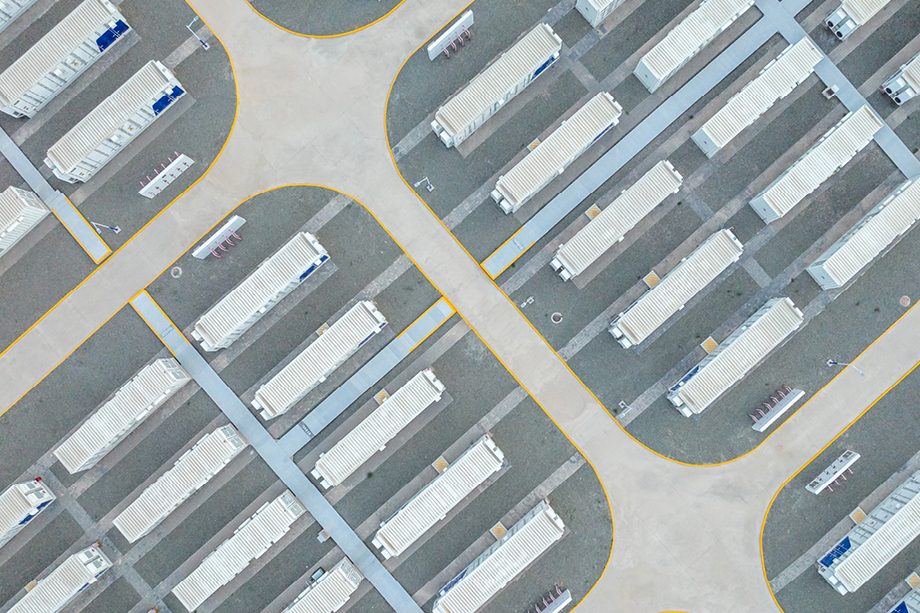
If grid expansion takes years to permit and build, battery storage offers something the grid badly needs today: flexibility. By storing power when it is abundant and releasing it when it is scarce, batteries can strengthen the grid in several ways like reliability and backup capacity, speed to power and energy arbitrage.
The market today: batteries are booming
Batteries are moving from niche to standard in renewable projects, unlocking new value streams and extending grid capacity. Yet public perception still underestimates the pace of the buildout - many investors continue to see batteries as too costly or not yet built at scale, despite clear evidence to the contrary.
Costs have come down dramatically: Lithium-ion batteries cost roughly $1,474/kWh in 2010; today they are about $108/kWh as global manufacturing capacity has scaled. Prices are 36% below 2020 levels, and BloombergNEF expects them to fall another 33% by 2030. To date, Chinese overcapacity has driven much of this cost decline - and we are monitoring policy changes, such as China's 5-Year Plan and its "Anti-Involution" campaign to curb excess capacity, that may affect future pricing.
Co-locating solar and storage is increasingly cost-effective. Solar output is highly predictable, which makes it a natural partner for storage - batteries convert low-cost, surplus daytime energy into dispatchable, on-demand power for nighttime peaks. When built together, co-located systems share one grid connection and construction crew, cutting total capex by around 20%. That advantage is reshaping how projects are developed. In Germany, hybrid projects can command a 40% premium to standalone solar power-purchase agreements.7
Policy tailwinds reinforce the buildout: In the U.S., incentives for grid-firming technologies were favored under the One Big Beautiful Bill Act. Solar projects seeking investment tax credits must be operational by the end of 2027 unless safe-harbored,8 while new battery storage projects can claim credits through 2035. These dynamics add value for hybrid projects and continue to incentivize storage deployment.
The result is a surge in deployment: Global storage additions were just 6 GW in 2020; today the market is 20x larger. BloombergNEF forecasts 122 GW of new storage in 2026, led by China (~45% share) and the U.S. (~20%). We remain constructive on the growth of battery storage worldwide as grids continue to shift towards renewables.
Barriers to watch
Battery storage brings stability for grid operators and profitability for renewable developers. But investors should also weigh certain embedded risks that raise questions around project feasibility.
Supply chain security: This is top of mind for investors in storage, as China dominates every stage of the battery supply chain - from critical mineral inputs to manufacturing components such as anodes, cathodes and cells.
Duration: As Michael Cembalest notes, hypothetically serving 24/7 data center demand with only solar and batteries would require stacking multiple storage systems and higher capex compared with a baseload gas system9. For solar plants, storage substantially boosts energy value up to 4 hours, but additional duration beyond that has limited incremental value.10 Near-term AI power needs are therefore likely to be met with a mix of gas, solar and storage, with long-duration technologies potentially becoming more relevant as cost and scalability improve.11
Doing more with the grid we already have
Alongside battery storage, utilities are increasingly prioritizing solutions that optimize and expand the flow of electricity cost-effectively without the need for new corridors. Replacing legacy wires with advanced conductors can double the current-carrying capacity of existing lines at less than half the cost, and on far shorter timelines, than new construction. Technologies such as dynamic line rating (DLR) and advanced power flow control (APFC) use monitoring tools to make better use of existing infrastructure, unlocking 10–30% additional effective capacity. BloombergNEF expects smart grid solutions to ramp-up through 2030, with investment growing at a 9% CAGR12.
The bottom line: power bottlenecks are a catalyst for innovation and investment
Rising power demand is colliding with permitting and supply-chain challenges, driving pricing power for electrical components and critical grid services while pressuring developers to manage execution risk. Investors who stay ahead of these trends will be best positioned to capture the next wave of growth.
The winners will be those who can deliver speed, reliability and flexibility - whether through grid-scale storage, power infrastructure expansion, or engineering and construction services. We see opportunities in industrial companies providing these solutions, as well as electric utilities with strong renewable and storage ambitions. These approaches prioritize resilience and speed, not just savings. Grid-enhancing technologies can ease congestion, cut renewable curtailment and meet rising demand while deferring the most costly, time-intensive upgrades. Today, optimizing capacity is a fiscal and operational imperative to maintain grid reliability as power consumption grows.

We can help you navigate a complex financial landscape. Reach out today to learn how.
Contact usLEARN MORE About Our Firm and Investment Professionals Through FINRA BrokerCheck
To learn more about J.P. Morgan’s investment business, including our accounts, products and services, as well as our relationship with you, please review our J.P. Morgan Securities LLC Form CRS and Guide to Investment Services and Brokerage Products.
JPMorgan Chase Bank, N.A. and its affiliates (collectively "JPMCB") offer investment products, which may include bank-managed accounts and custody, as part of its trust and fiduciary services. Other investment products and services, such as brokerage and advisory accounts, are offered through J.P. Morgan Securities LLC ("JPMS"), a member of FINRA and SIPC. Insurance products are made available through Chase Insurance Agency, Inc. (CIA), a licensed insurance agency, doing business as Chase Insurance Agency Services, Inc. in Florida. JPMCB, JPMS and CIA are affiliated companies under the common control of JPMorgan Chase & Co. Products not available in all states.
Please read the Legal Disclaimer for J.P. Morgan Private Bank regional affiliates and other important information in conjunction with these pages.
Bank deposit products, such as checking, savings and bank lending and related services are offered by JPMorgan Chase Bank, N.A. Member FDIC.
Not a commitment to lend. All extensions of credit are subject to credit approval.