

Oct 16, 2026
When Markets Feel Like a Bubble: What Should Investors Do?
Once a digital curiosity—an experiment born of distrust in the financial system—bitcoin, a cryptocurrency,1 is now being debated in boardrooms and considered by some of the world’s largest institutions.
Mounting U.S. debt, declining trust in institutions, a generational wealth transfer and the rapid evolution of digital assets (bitcoin and others) have some clients asking: Is my portfolio ready for bitcoin?
Our answer: We don’t currently recommend it as part of a core allocation. The bull case for bitcoin is strengthening, yet we see important reasons to remain cautious. Regulation is only beginning to solidify, volatility remains relatively high for a standalone asset, and history suggests bitcoin could contribute outsize risk to a portfolio.
Proponents argue bitcoin could become a widely adopted digital store of value, like a digital gold. They point to:
Bitcoin’s market capitalization, just below $2 trillion, is large for a single security (it’s roughly the market cap of Meta). To be sure, it’s small compared to traditional asset classes—$2 trillion is just 6% of gold’s total market cap. We caution against drawing direct parallels, given their still distinct features, but bitcoin bulls commonly speculate that if bitcoin’s market cap were ever to match gold’s, a coin would theoretically be worth more than $1.5 million—about 20 times higher than today.
This combination of scarcity, growing mainstream acceptance and decentralization underpins the optimistic outlook for bitcoin’s long-term value.
Indeed, while the bull case is compelling, we note several risks and uncertainties that must be weighed carefully before considering any allocation.
One reason why we don’t think bitcoin is ready for core portfolios is the regulatory landscape. In 2025, most economies signaled an opening toward the digital assets ecosystem,6 which supported bitcoin’s entry into institutional finance. But the environment is fragmented overall.
Policy progress or regression lies in policymakers’ hands, and while the lack of global regulatory consistency is inherent in decentralized assets, it leaves investors without the protections and stability that oversight is intended to provide. Although bitcoin is generally further along its regulatory journey than other parts of the ecosystem, its acceptance has been bolstered by advancements in digital asset regulation as a whole.
Striking a balance between regulations that foster investor confidence and cryptocurrencies’ original, decentralized purpose will likely remain a key challenge for the industry.
Bitcoin is notorious for its volatility. Over the past decade, bitcoin has been four times more volatile than global equities—nearly 70%, versus global equities’ 16%. Bitcoin has also seen 14 bear markets (meaning a decline of 20% or more) over the same period; global equities had two. And bitcoin’s declines have been worse: The average loss, during bitcoin’s five worst declines, was 57%. For global equities, the five worst slumps averaged to a 21% decline.
However, because bitcoin is a relatively new asset, the period used for analysis matters. Recently, bitcoin’s volatility has been easing. Since the SEC approved the first bitcoin spot ETFs in January 2024, the cryptocurrency’s annualized volatility has been about 45%, much lower than that of the prior decade.
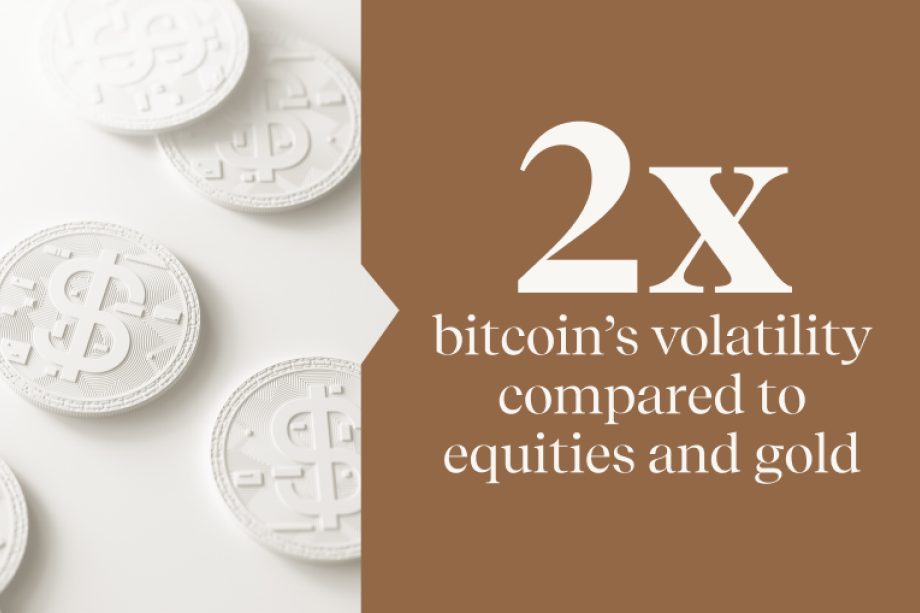
Bitcoin’s decline in volatility could reflect growing institutional acceptance and the maturation of the asset. Yet even so, its one-year volatility is still more than twice that of broad equities and gold. The price action over the past few months serves as a good example that such volatility may not be suitable for all investors or portfolios.
Volatility isn’t necessarily a bad thing on its own, and investors historically have often been rewarded for holding through it. For example, those who bought and held bitcoin over the past decade saw an annualized return of 72%.
Bitcoin’s correlation with other assets has fluctuated significantly. It has a low long-term correlation to global equities (around 0.2), but that tends to spike during periods of market turmoil.
Whenever global equities gained 5% or more over a four-week period (“risk-on”), bitcoin was up 75% of the time, and gold was up 73% of the time. However, whenever equities declined 5% or more (“risk-off”), bitcoin was down 93% of the time, while gold was down only 55% of the time.
In “risk-off” periods, equities averaged an 8% loss. During those same periods, bitcoin fell by an average of 13%, while gold gained 0.4% on average.
Historically, bitcoin hasn’t consistently protected portfolios during equity market weakness. Instead, those were the times it tended to perform worse.
Beyond equities, a common narrative is that bitcoin can act as a currency diversifier. While it has had a slightly negative correlation with the U.S. dollar (-0.14) over the past decade, gold has served as a more reliable USD diversifier, with a correlation of -0.50 over the same period.
Bitcoin’s unique characteristics make it difficult to classify using traditional asset allocation frameworks. It offers the potential for capital appreciation and some degree of currency diversification, but it also introduces significant risk.
Here’s how a bitcoin allocation compares to other diversifiers and may affect your portfolio’s risk:
For ultra-conservative portfolios or near-term funds, even a small bitcoin allocation may introduce unacceptable volatility and drawdown risk. Aggressive or opportunistic investors may consider sizing bitcoin within their risk budgets, but careful sizing and risk management are essential.
The digital asset landscape is rapidly evolving, and bitcoin is only one part of it. Tokenization—the representation of real-world assets as digital tokens on a blockchain7—is broadening access to alternative investments and streamlining asset management. Blockchains now function as settlement rails for transferring and recording asset ownership, enabling instant, transparent and cost-effective value transfers across global markets.
Since January 2025, financial institutions’ adoption of blockchain-based products and strategies has accelerated.8 As investors become more familiar and comfortable with the technological ecosystem bitcoin inhabits, adoption of the coin may accelerate.
And as the digital asset ecosystem beyond bitcoin expands, new opportunities and risks to bitcoin’s progress may also rise. The increasing adoption of USD-pegged stablecoins, to take one commonly cited example, could reinforce the dollar’s dominance. The USD peg could help provide more efficient and secure cross-border transactions and settlement. Yet it could also slow the broader de-dollarization trend of the past year and work against wider crypto adoption.9
Bitcoin is still on its journey from digital curiosity to widely used asset. While we currently do not recommend bitcoin as part of a core portfolio, it may suit aggressive and/or speculative investors as a satellite allocation, if they’re willing to accept its risks and volatility. Bitcoin has shown its potential for significant returns in the past, but future outcomes remain uncertain, so careful sizing and risk awareness are essential.
Beyond bitcoin, the digital asset ecosystem is evolving rapidly. As new technologies and platforms develop, they may help build the infrastructure cryptocurrencies need—for broader market acceptance, and to win our confidence, as well.
As always, aligning portfolio construction with your long-term goals and risk tolerance is paramount. Your J.P. Morgan team can help you navigate the risks and opportunities of bitcoin and the broader digital asset landscape.

All market and economic data as of January 31, 2026, and sourced from Bloomberg Finance L.P. unless otherwise stated.
This webpage content is for information/educational purposes only and may inform you of certain products and services offered by private banking businesses, part of JPMorgan Chase & Co. Products and services described, as well as associated fees, charges and interest rates, are subject to change in accordance with the applicable account agreements and may differ among geographic locations. Not all products and services are offered at all locations.
J.P. Morgan Securities LLC and its affiliates do not endorse, advise on, issue, intermediate, mine, custody, store, administer, transmit, exchange, control, sell or transact directly in any type of virtual currency or digital asset. This does not include financial instruments that derive their value from virtual currency that JPMS may make available for purchase or sale.
Digital Asset Products are investment products typically designed to track the performance of a specific digital asset, including cryptocurrencies (e.g., bitcoin, Ethereum, etc.), through a traditional investment vehicle that tends to be a passive strategy, tracking a specific cryptocurrency index. Due to the high volatility of digital assets, Digital Asset Products may also experience high volatility and reflect an increased sensitivity to news, speculation and manipulation. Additionally, digital assets and Digital Asset Products are relatively new compared to other asset classes and types of investment products, and as a result, there is limited data on their performance; they remain subject to ongoing regulatory uncertainty; and they remain subject to technological and market developments. Investors should understand these securities and be ready to manage the associated risk carefully before making an investment decision. Learn about the risks of complex registered funds (PDF) and all specific risks in the relevant security prospectus.
We can help you navigate a complex financial landscape. Reach out today to learn how.
Contact usLEARN MORE About Our Firm and Investment Professionals Through FINRA BrokerCheck
To learn more about J.P. Morgan’s investment business, including our accounts, products and services, as well as our relationship with you, please review our J.P. Morgan Securities LLC Form CRS and Guide to Investment Services and Brokerage Products.
JPMorgan Chase Bank, N.A. and its affiliates (collectively "JPMCB") offer investment products, which may include bank-managed accounts and custody, as part of its trust and fiduciary services. Other investment products and services, such as brokerage and advisory accounts, are offered through J.P. Morgan Securities LLC ("JPMS"), a member of FINRA and SIPC. Insurance products are made available through Chase Insurance Agency, Inc. (CIA), a licensed insurance agency, doing business as Chase Insurance Agency Services, Inc. in Florida. JPMCB, JPMS and CIA are affiliated companies under the common control of JPMorgan Chase & Co. Products not available in all states.
Please read the Legal Disclaimer for J.P. Morgan Private Bank regional affiliates and other important information in conjunction with these pages.

